Beyond the Spreadsheet: Why America's Athletes Are Fighting Back Against the Data Takeover

The Revolution That Went Too Far
Somewhere between "Moneyball" and today, American sports fell in love with numbers. Really, really in love. So much so that we started treating athletes like algorithms and games like mathematical equations waiting to be solved.
But now, after two decades of the analytics revolution, something interesting is happening: the players themselves are pushing back.
"You can't measure heart," says a veteran NBA coach who requested anonymity. "You can't put a number on what happens when a guy just refuses to lose. But that's exactly what we're trying to do, and we're missing the whole point of why we fell in love with sports in the first place."
When Numbers Started Running the Show
It began innocently enough. Billy Beane showed baseball that undervalued players could be found through statistical analysis. The concept was brilliant – find market inefficiencies and exploit them.
Fast forward to today, and every major league team employs armies of data scientists. NBA teams track over 3,000 data points per game. NFL coaches make fourth-down decisions based on win probability models. Baseball managers pull starting pitchers based on "times through the order" statistics.
The numbers became so important that they started overruling what players and coaches could see with their own eyes.
The Players Fight Back
Basketball's Instinct Warriors
LeBron James has been one of the most vocal critics of over-reliance on analytics. "I've been playing this game for 21 years," he said recently. "Sometimes you just know what the right play is, regardless of what the computer says."
 Photo: Golden State Warriors, via basketballjerseyarchive.com
James isn't alone. Veterans across the league talk about the frustration of having their basketball IQ questioned by spreadsheets. They've lived thousands of game situations, developed instincts through years of competition, only to have front offices second-guess their decisions based on data models.
Giannis Antetokounmpo put it perfectly: "Basketball is not played on paper. It's played with emotion, with energy, with things you can't measure."
Baseball's Human Element
The sport that started the analytics revolution is now seeing its biggest pushback. Veteran managers like Dusty Baker have long argued that situational awareness and player psychology matter more than launch angles and exit velocities.
"I can look at a hitter and tell you if he's seeing the ball well," Baker explains. "I can watch my pitcher's body language and know if he's losing his stuff. No computer is going to tell me that."
Players echo this sentiment. When analytics departments suggest lineup changes based on platoon advantages or matchup data, veteran players often know better. They understand which teammates perform better in clutch situations, regardless of their season-long statistics.
The Human Factor That Numbers Miss
Chemistry and Leadership
Analytics can tell you that Player A has better defensive metrics than Player B. What they can't measure is that Player A is a locker room cancer while Player B makes everyone around him better.
Tom Brady's career is the perfect example. His arm strength, speed, and measurable physical attributes were never elite. But his leadership, clutch gene, and ability to elevate teammates in crucial moments led to seven Super Bowl championships.
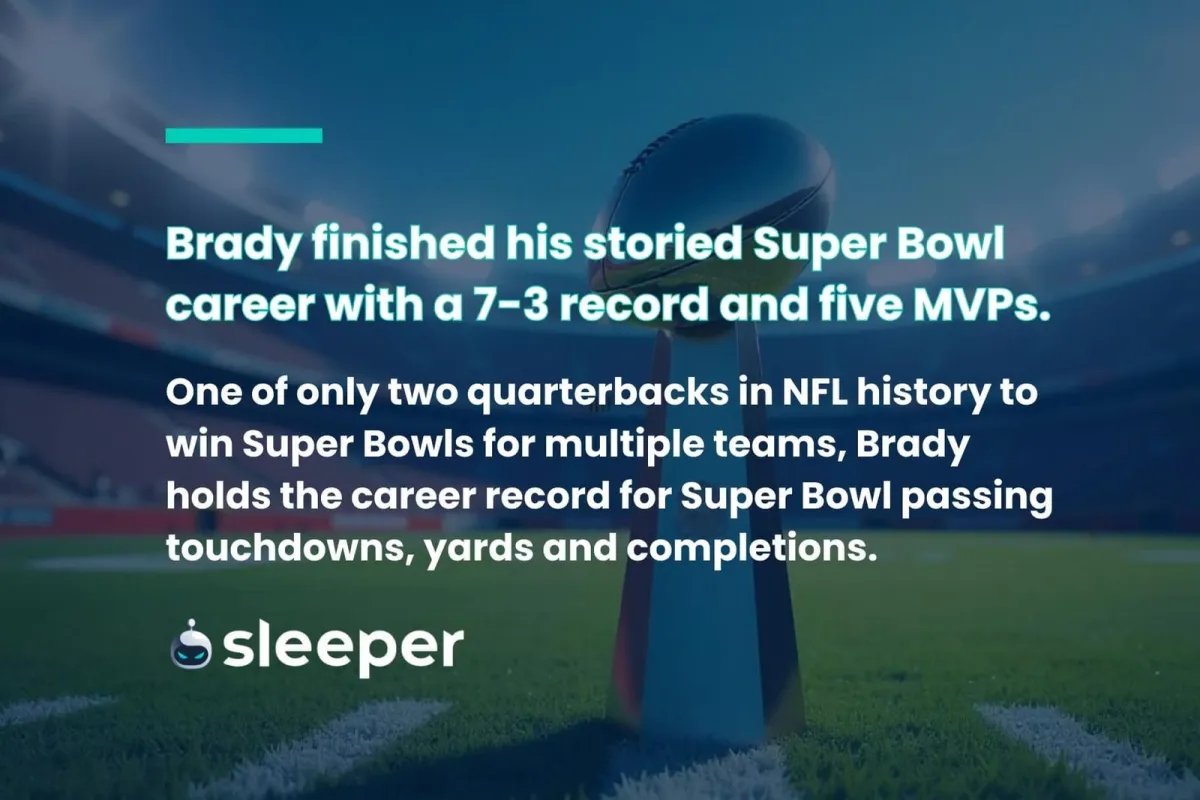 Photo: Tom Brady, via sleeper.com
"You can't quantify what Brady brought to a huddle in the fourth quarter," says a former Patriots assistant coach. "The confidence, the calm, the way he made everyone believe they were going to win – that's not in any database."
The Momentum Myth
Analytics departments love to say that momentum doesn't exist, that each play is independent of the previous one. Players laugh at this notion.
"Tell me momentum doesn't exist when you're in a hostile road environment and you just made three straight stops," says a veteran NFL linebacker. "Tell me it doesn't matter when your offense is clicking and everything's working. The numbers guys have never felt that energy."
When Analytics Get It Wrong
The 2016 Warriors
Golden State had the best regular season record in NBA history, largely built on analytics-driven strategies. But in the Finals, LeBron's Cavaliers showed that heart and determination could overcome statistical advantages.
The Warriors' analytics suggested that small-ball lineups and three-point shooting would dominate. What they didn't account for was Cleveland's emotional investment and LeBron's superhuman performance when facing elimination.
Baseball's Postseason Unpredictability
Every October, baseball's analytics experts watch their carefully crafted models get destroyed by hot streaks, clutch hitting, and inexplicable performances from unlikely heroes.
The 2019 Washington Nationals had a 1.6% chance of winning the World Series according to some models after starting 19-31. They won it all, led by aging veterans who "shouldn't" have been capable of such performances.
Finding the Balance
This isn't about completely abandoning analytics. Smart teams are learning to blend data with human insight, using numbers as tools rather than gospel.
The best coaches and general managers use analytics to inform decisions, not make them. They understand that while data can reveal trends and tendencies, sports are ultimately played by humans in high-pressure situations where unpredictable things happen.
The Future of the Game
As younger players enter professional sports having grown up with analytics, the debate continues to evolve. Some embrace the data-driven approach, while others cling to traditional instincts and feel.
What's becoming clear is that the most successful teams will be those that find the sweet spot – using analytics to gain advantages while never forgetting that sports are fundamentally human endeavors filled with emotion, instinct, and magic that no algorithm can capture.
Because at the end of the day, games aren't won by spreadsheets. They're won by players who refuse to quit, coaches who make gut decisions at crucial moments, and teams that believe in something bigger than what the numbers say is possible.
And that's exactly how it should be.