The Review Room Is Ruining Your Game: Why Instant Replay Has Gone Too Far
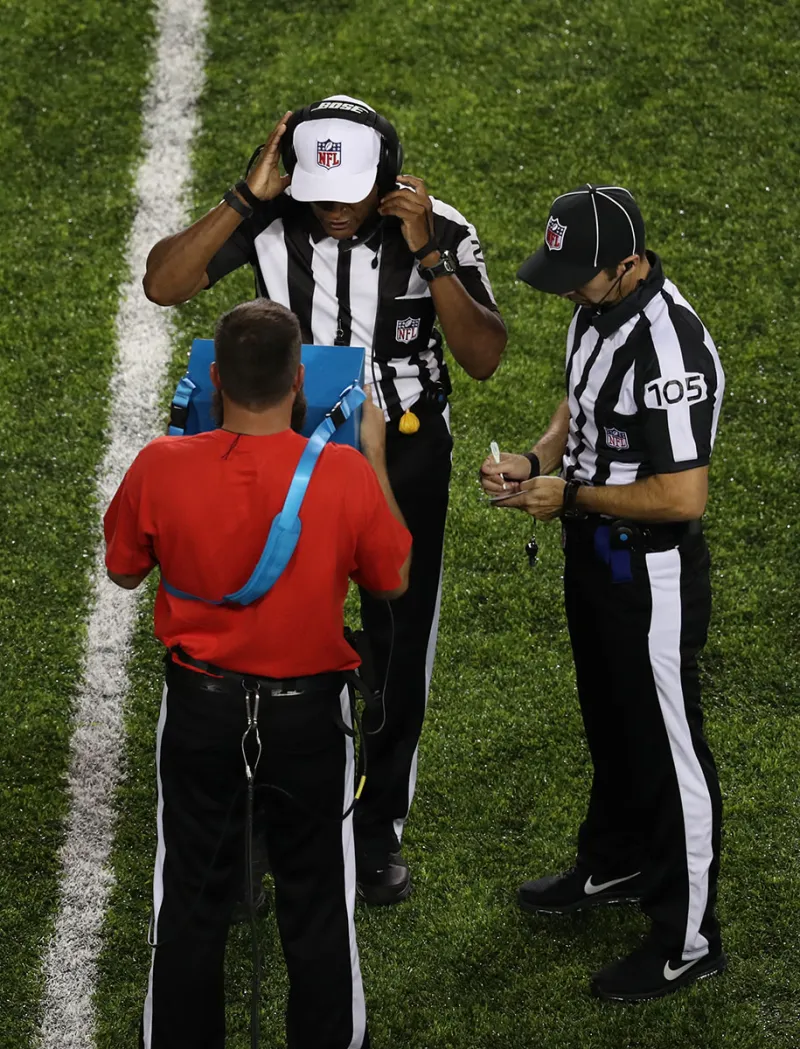
Photo: NFL referee reviewing instant replay challenge flag stadium, via winblogs.thesourcemediaassets.com
Opinion
Let me paint you a picture. It's a Sunday afternoon, packed stadium, fourth quarter. Your team just scored a touchdown that sent 70,000 people into absolute chaos. You're hugging a stranger. Someone spills beer on your shoes and you don't even care. It's one of those moments — pure, loud, electric — that reminds you why you love sports.
And then the referee raises his hand and points to the sky.
Under review.
The stadium goes quiet. The replay officials in some windowless room somewhere start squinting at camera angles. Three minutes pass. Then four. A buzzkill descends over the building like a weather system. The touchdown stands — it was clearly a touchdown — but the moment is gone. You can't get it back. The air has been let out of the balloon.
This is happening constantly now. And it is slowly, methodically killing the thing that made sports great in the first place.
How We Got Here
The case for instant replay was always reasonable on the surface. Referees are human. They make mistakes. High-stakes games shouldn't be decided by a blown call that a camera angle could have corrected in ten seconds. When the NFL introduced the challenge system in 1999, it felt like a sensible safety net. A way to fix the obvious disasters without disrupting the flow of the game too badly.
The problem is that sports organizations can't help themselves. Give them a little review authority and they'll keep expanding it. What started as a mechanism for overturning clear fumble miscalls has metastasized into a sprawling bureaucracy that reviews whether a receiver's second foot was technically inbounds, whether a defender's pinky grazed a jersey in a way that constitutes pass interference, and whether a ball that clearly crossed the line actually crossed it according to the specific pixel-level standard required for reversal.
Soccer's VAR — the Video Assistant Referee system used in the Premier League and major international competitions — has become a genuine cultural flashpoint on both sides of the Atlantic. American soccer fans who tuned in for the World Cup experienced the full VAR horror show: goals disallowed after two-minute reviews for offside calls decided by a line drawn across a freeze-frame of someone's armpit. The frustration isn't coming from fringe critics. It's coming from everyone.
The Momentum Problem Nobody Wants to Admit
Here's what the replay defenders never adequately address: momentum is real, and stopping play kills it.
Sports are emotional experiences. They operate on rhythm and energy. A team that's been on an 8-0 run in basketball doesn't just benefit from the points — they benefit from the psychological weight of the moment, the crowd feeding them energy, the opponent rattled and scrambling. Stop the game for a replay review in the middle of that run and you've handed the trailing team a free timeout. You've broken the spell.
In football, a big defensive stop that would have shifted momentum completely — the kind of play that swings a game — gets neutered when it's immediately flagged for review. Players don't know whether to celebrate. Coaches can't make decisions. The crowd doesn't know how to feel. Everyone just... waits.
Baseball's replay system, which was supposed to be limited and efficient, has expanded to cover almost every close play on the bases. Managers stand in the dugout with a phone to their ear, waiting for a call from a video team upstairs telling them whether to challenge. The game pauses. Players stand around. Fans who came to watch baseball watch men standing in a field looking at their cleats.
The "Getting It Right" Fallacy
The argument that always shuts down replay criticism is this: don't you want them to get the call right?
It sounds unanswerable. Of course you want correct calls. But this framing contains a hidden assumption — that sports are primarily about achieving a perfectly accurate record of what happened. They're not. Sports are about the experience of competition. About drama, tension, uncertainty, and the human element.
Bad calls have always been part of sports. Controversial officiating decisions have produced some of the most memorable moments, debates, and storylines in American sports history. The Tuck Rule Game. The Dez Bryant catch that wasn't. The 2002 NBA Western Conference Finals. These moments live in the culture because they were imperfect, because they were argued about, because they felt human.
When you remove every controversial call through review, you don't create a better sport. You create a more accurate sport that feels less alive.
And here's the uncomfortable truth the replay advocates never want to sit with: even with all this review technology, they still get calls wrong. The standard for reversal is so high — "indisputable visual evidence" in the NFL — that plenty of questionable calls survive review anyway. So you've slowed the game down, killed the momentum, and still didn't fix the problem. The worst of both worlds.
What Needs to Change
This isn't an argument for abolishing review entirely. There's a version of replay technology that works — limited in scope, quick in execution, reserved for genuinely consequential errors.
The NFL's challenge system, for all its flaws, at least puts the decision in the hands of coaches who have to spend a resource to trigger a review. That's a reasonable friction mechanism. The problem is that the league has layered automatic reviews on top of it for scoring plays and turnovers, removing any friction entirely.
Soccer's VAR needs a complete overhaul. The offside review process — with its freeze-frame line-drawing and sub-inch decisions — is a technical exercise that has nothing to do with the spirit of the game. Offside was designed to prevent goal-hanging, not to disallow goals because a player's shoulder was geometrically ahead of the last defender. Fix the standard, not just the technology.
Baseball should put a hard time limit on reviews — 90 seconds, call it, move on. The game already has a pace problem. Giving managers a phone-a-friend option that drags on indefinitely doesn't help.
And everyone — every league, every federation — needs to accept a principle that sounds radical but is actually obvious: some calls will be wrong, and that is okay. It has always been okay. Sports survived for over a century on the authority of the referee standing in front of them. The game was fine.
Give Us the Game Back
The next time you're watching a game and a review stoppage kills a moment that should have been electric, remember that this wasn't inevitable. Someone decided to keep expanding these systems. Someone decided that accuracy was more important than experience. Someone decided that a sport watched by millions of people for the joy of it should feel more like a legal proceeding.
The fans didn't ask for this. And the fans should be louder about demanding something different.
Because sports, at their best, are not about getting every call right. They're about feeling something. And right now, the review room keeps taking that feeling away.